













Peter Eastway's Better Photography Magazine

Create an Account to Receive Free Weekly Email Newsletter
The Eyes Still Have It
Written by Peter Eastway   

There is no television for these young monks, although that is a supposition. During my short stay in Bhutan and my limited and even shorter walks around the monasteries, I didn't see any television or videos. So I made the assumption that there wasn't much in the way of electronic entertainment for the monks, although most of my hotel rooms had televisions.

I then took my theory a little further whlle watching these young monks and taking their photograph. They didn't even notice me, another supposition. They didn't appear to notice me! So my theory was that they stood watching the dancing in the Jakar Dzong with the intensity our youth would watch the latest block-buster video. The festivals were their blockbusters!

The older monk (another supposition) seems more worldly than his young companion, and while his serene face shows no clue to his emotions, his right hand possibly expresses some minor tension. Maybe he is watching his friends dance, wishing them success, hoping they don't mess up their moves.

The young monk is not so sure. Perhaps he is also worried about his friends dancing, or perhaps he is fully engrossed in the stories that the dancers tell. His hands definitely show some tension, no doubt the same type of tension experienced at home while watching a movie.

This photograph was turned into monochrome using Capture One 7. I also used the Capture One clarity and structure sliders, the clarity to smooth the skin (by pushing it to the left for a negative value) and the structure to help the eyes pop. The light reaching their faces is hardly touched, just a slight increase in contrast, while their skin has been lightened by shifting the red and yellow sliders up in the monochrome conversion dialog.

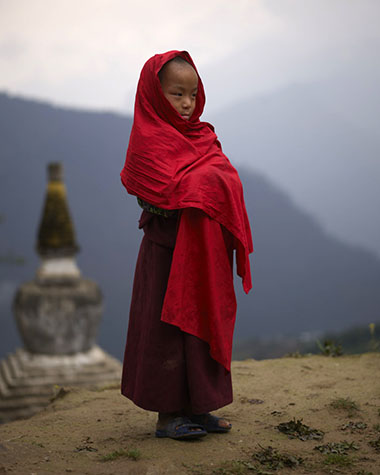
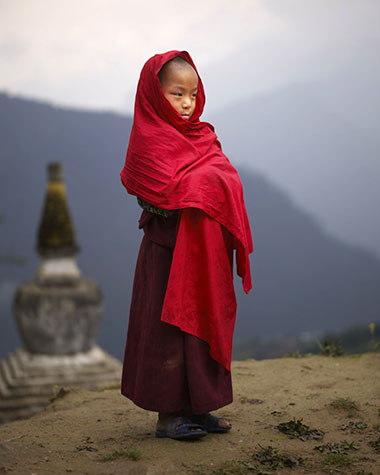
So does black and white work better than colour? Here are two more photos from the same session, but I have left them in colour. Does colour still rule? Or doesn't it matter because it is all in the eyes?


1 Comment

Photoshop 201
Written by Peter Eastway   

Book Now! Photoshop 201 Workshop: - Sydney, 14 July, $395

I am repeating my Photoshop 201 workshop on Sunday, 14 July at L&P in Artarmon. The workshop runs from 11 am to 5 pm and covers all the essentials of using layers, making masks, understanding blend modes and so on. All you need to do is spend the afternoon with me and you will leave the workshop with a full understanding of layers, plus example files and notes for reference.

For more details, please follow this link.


0 Comments

Buy An Eizo, Get A GoPro
Written by Peter Eastway   

Eizo's introductory CS230 is a 23-inch monitor and if you buy soon, comes with a GoPro camera!.

Eizo has a promotion that might just interest you! Buy a new Eizo ColorEdge monitor before the end of July and receive a GoPro Hero3 White Edition HD camera for free!

There are several ColorEdge models, beginning with the entry-level CS230, which has a 23-inch high definition screen with a built-in correction sensor. With a full sRGB gamut, this monitor is particularly well-suited to those who publish to the web and edit video.

The CG223W has been available for more than two years and remains a popular and affordable favourite worldwide. With a 22-inch screen and wide colour gamut, the CG223W is ideal for pre-press and photography. It comes with an Ambient Light Hood and the ColorNavigator calibration system for hardware calibration.

The CX range is available in 24-inch and 27-inch screen sizes as the CX240 and CX270, respectively. Both will suit professional photographers and designers who require a wide colour gamut and uniform brightness from corner to corner.

Eizo's flagship CG246 and CG276 monitors feature 24-inch and 27-inch screen sizes, respectively. Designed for discerning imaging and graphics professionals, these screens can reproduce 97% of the Adobe RGB colour space, enabling images captured as raw files to be displayed with their full colour and tonal gamuts. Both models include built-in SelfCalibration sensors that eliminate the need for a third-party calibration device.

Prices for the monitors listed above range from AU $1,650 to AU $3,500. The GoPro Hero3 White Edition HD Camera is valued at AU$269.For more information, visit eizo.com.au/promotion/may.html


0 Comments

Nice Photo, But Did I Miss The Best Ones?
Written by Peter Eastway   

Photographed at Arnarstapi, Iceland.

A little over a year ago, I was driving around southern Iceland with Kevin Raber and the Phase One PODAS. Our first day was disappointing, to say the least, because the landscape was shrouded in low cloud and heavy rain. Actually, I shouldn't say 'disappointing' because I have a dozen shots taken out of a rain-splattered windscreen which I think look pretty good. But I digress!

One advantage of shooting in Iceland in May is that the sun sets late and comes up early, so although we didn't get much photography done on our first day, by getting up at 2.00 am the following morning and retracing our steps, we managed to photograph most of the places we wanted to and still managed to catch up with our original program. Nothing was missed!

Well, maybe nothing. I'm pretty happy with this photograph at Arnarstapi. It's half an hour up the road from the black church which regular readers may remember from recent newsletters. There are some amazing volcanic rocks sitting just off the coast and I spent a wonderful morning photographing them with long exposures.

The image above was a 30 second exposure with a 10X neutral density filter, using an IQ180 digital back and a 23mm Rodenstock Digaron. It's my standard wide-angle Alpa rig and I use it a lot!

Yet behind me was a quaint little village with some ramshackle buildings, ringed by ponds of still water, reflecting a backdrop of majestic, snow-covered volcanoes. Should I have turned the camera around?

To be fair, I did shoot a few photos of the little village, but while doing so, all I could think about were the rocks off the coast behind me. I can assure you it was a very confusing morning, trying to work out how to make best use of my time, realising we didn't have too much of it!

The original file processed out of Capture One.

It's low tide, which is good for these rocks, I think, but I'd like to shoot here at high tide because there are some other locations that could use the extra water very well. The white specks are nesting birds, but what's really missing in this small reproduction is the incredible texture and detail in the volcanic islets themselves.


0 Comments

Wacom Cintiq 24HD Touch
Written by Peter Eastway   


Feel like an artist when you use Wacom's Cintiq. It's a big unit, very robust and a lot of fun to use.

Do you spend a lot of time carefully finessing your photographs on screen? Have you discovered the ultimate technique for hands-on immersion?

If you work on your images in Photoshop or Elements, this is nearly the ultimate. Opening up your images and working directly on them, using the touch rings and express keys to navigate around Photoshop or your image editing program, becomes fast, efficient and lots of fun.

The Cintiq is not a small device, featuring a 24-inch touch screen with a sturdy base that holds the screen securely in a range of different positions, from almost flat to almost vertical. This allows a number of different working positions and I find I change the screen position from time to time, depending on what I am doing. The large paddles on the side of the screen make this very easy to do.

The software accompanying the Cintiq is very similar to Wacom’s Intuos tablets, allowing you to customise what the speed rings and express keys (on the sides of the Cintiq) do. For instance, in Photoshop I have set up a number of actions (such as add a curves adjustment layer) and set them to a function key. Then, in the Wacom software, I assign that function key to one of the express keys on the Cintiq, so whenever I am in Photoshop and using the Cintiq, a touch of that button brings up my curves adjustment layer.

The entire Cintiq package has been brilliantly thought out, including the touch screen which means I can work without a stylus if I want to. However, I prefer the stylus and it works on both the Cintiq and my Intuos tablet which remains connected to my system. My work bench currently has an Eizo CG275W with a keyboard and Intuos tablet in front of it, and the Cintiq immediately to the right. I simply roll my chair from one to the other, depending on what software I am using (the Cintiq isn’t much use for writing articles in Word, for instance).

I love working on the images directly using the Cintiq. However, the Cintiq screen is not as sharp as my Eizo monitors and so I find myself using the Cintiq as a mirror display, giving me what I think is the best of both worlds!

If you get a chance to play with this device, take it! For more information, visit www.wacom.com.au. The 24HD Touch is around AUS $4235, the non-touch version around $2895.


0 Comments

When Do You Take The Photo?
Written by Peter Eastway   

Photographed on the Adventures in Oz workshop, 2012. 'The' gum at Ormiston Gorge.

Ormiston Gorge, not far from Glen Helen Gorge in the Western MacDonnells, is one of the highlights of a trip to the Red Centre. Two or three hours west of Alice Springs, it's relatively easy to visit, there's a car park, a path and once at the top, you're in the heart of it!

I first photographed this tree (I am assuming it is the same tree) some twenty years ago. Mind you, now that I think about it, perhaps it was another tree on the same spot because this tree isn't that big. Then again, maybe the trees don't grow very tall in this area. Hmmm. Last time I was there it was early morning and I have always remembered the way the white bark glowed in the pre-dawn light - and how disappointed I was because the tree was moving in the pre-dawn light and the resulting image was blurred.

The same happened on this trip, that annoying zephyr that seems to accompany dawn as it races around our globe. So while I photographed the tree in the pre-dawn light, I also remained for the sunrise so I could use a faster shutter speed and stop the movement. So, given I was using a different light source, when would the tree look its best?

Our group was up early so we had plenty of time to work out the best angles. There's a sign right next to the tree and a railing behind. In fact, the location is now a very well appointed look-out with all the trimmings required, so I had to position the camera down low so these manmade intrusions were not overly obvious. In the photo above I have removed the sign and some of the railing in Photoshop, but not in the other images which have been only quickly edited. Even so, you'll have to look hard to see them - they are pretty well hidden in the bottom right corner...

In this shot, the sunlight hasn't touched the tree as all and, to my mind, it looks less interesting than the image above.

We also had some other bushes near the camera that were intruding into the scene, so I had to gently hold them back out of the picture while each exposure was made. Please be assured that no flora was damaged in the making of this photograph.

I also took a series of images. The first had sun on the rock face, but not on the tree (shown above). The second had a splash of sun on the tops of the tree. The third had the sun extending down most of the trunk, but not lighting up the foreground. And the final one is the image at the top, where the foreground is just being kissed by the sun.

The question of when do you take the photograph was easy to answer: having travelled several days to reach my destination, I took as many frames as necessary so I could decide later on which was the 'best'.


Which would you chose? Although I have only worked the top file (the others are just out of the raw processor), you can get a feeling for how the light works on the tree. My initial thought was that the sun should only appear on the top half, not the bottom, but looking at it later, I think the sun all the way down the trunk produces great separation between the tree and the background.

If you'd like to read a blog about our Adventures in Oz workshop last year, you'll find it under the Blog menu above, or you can click here.


2 Comments

Judges Are Not Philistines!
Written by Peter Eastway   

Black Church - Gold Award Afterall - 2013 NSW AIPP Epson Professional Photography Awards

It can be difficult working out what photos to enter in a competition. We all have a lot of emotional baggage attached to our best photos and that can cloud our vision. Mind you, to win awards, sometimes you simply have to go with your gut instinct and hope that the judges like what you do.

With my winning landscape portfolio from the 2013 NSW AIPP Epson Professional Photography Awards, I mentioned last week that one of the prints bombed. A friend thought he saw the print score 79 and, although I earned two Golds and a Silver for the other prints, I really felt a bit bummed with such a low score.

I mean, let's face it, when you enter your prints to a competition, you're pretty proud of them. You don't normally put in a photo expecting to get a bad score. However, I have been doing this for a few years and, in my arrogance, thought I knew what would score a Silver at least. So, the 79 was a problem - one point off Silver. But I couldn't complain about the judges because they had been so fair with the other scores! A bit hard to call the judges names when they obviously have such good taste with other images!

My four prints came back in their case late last week. Normally the print case gets put in the corner of the studio until it is needed, sometimes 12 months later, but I just wanted to have a look at my black church again, to try and resolve in my own mind what was wrong with it.

When I opened the case, my certificates were on top and included three golds. Oh, that's great, rub salt into the wound, I thought! Then I looked on the back of the print: the score was 90, a Gold Award!

Isn't it funny how good things like this can make you feel. I felt the whole system of judging was vindicated, even though I have written a book on photography competitions where I suggest to readers not to get too caught up in it all because, after all, it is just a matter of opinion.

So, three Golds in the State awards - what will they score at Nationals? Unfortunately, there is no guarantee they will do as well, if that's what I enter. Even so, I need to find at least another print to replace my silver!


0 Comments

Better Photography Photograph of the Year 2013
Written by Peter Eastway   

Photography Competition Now Open - 31 July Closing Date

This year's annual Better Photography Magazine photo competition is open with an extended pool of category prizes, a great $5000 cash first prize, plus the promise of a short critique for every photograph entered.

Now, being mindful that entry is $20 a print or five entries for $80, the critiques are not exhaustive or in depth. However, as judges we often wish we could make a small suggestion to help the entrant improve. For instance, just to mention 'more contrast' to an entrant might indicate that their photo is a little flat, or 'Crop Image' may suggest that there is too much going on in the frame and a little judicious trimming could strengthen the composition.

So, with this in mind, each entry will get a score and a comment or suggestion. Of course, if the image has earned a high score, then the comment might simply be, "I wish I had taken this photo" - and that, I daresay, would be well-received too!

To visit the competition website, go to the Better Photography website and follow the Other Links menu, or you can go there directly by clicking here.


0 Comments

  • «
  •  Start 
  •  Prev 
  •  1 
  •  2 
  •  3 
  •  4 
  •  Next 
  •  End 
  • »


Page 1 of 4
Banner
Banner
Banner
Banner
Banner
Banner
Banner
Banner

Online Shopping

Download Area

RSS Feeds

Your Cart

Your Cart is currently empty.

You are here  :
Banner